My weekends are when I try to watch some of the insightful videos on the internet. So, I watched Zerodha’s new Subtext episode with Sidu Ponnappa twice this week. That doesn’t happen often usually with most videos on YouTube. The first time I watched it like a podcast. The second time I paused it every few minutes to write things down, and the notes grew long enough that I turned them into a page helped with my custom explainer HTML skill, that I have been honing.
Sidu sold his first company, C42 Engineering, to Gojek and ran engineering there for years. His current company, Realfast, sells IT services done with agents. He told the hosts, Pranav Manie and Bhuvanesh R, that he could be “horrendously wrong” about all of it, and then argued every point as if he wasn’t. I like that brutal honest style of his.
The part I keep thinking about
Most of us talk about an agent as if it were a junior colleague. You give it a task, it goes off, and it comes back with something you check. Sidu says that picture is wrong, and that it’s dangerous with today’s models.
The way he actually uses an agent, it’s closer to his own fast, automatic thinking. He decides what he wants, and the agent does it the way his hand reaches for a glass of water. In Kahneman’s terms, the agent is your System 1, not a second System 2. He says this is the one belief he has turned around completely in the last year.
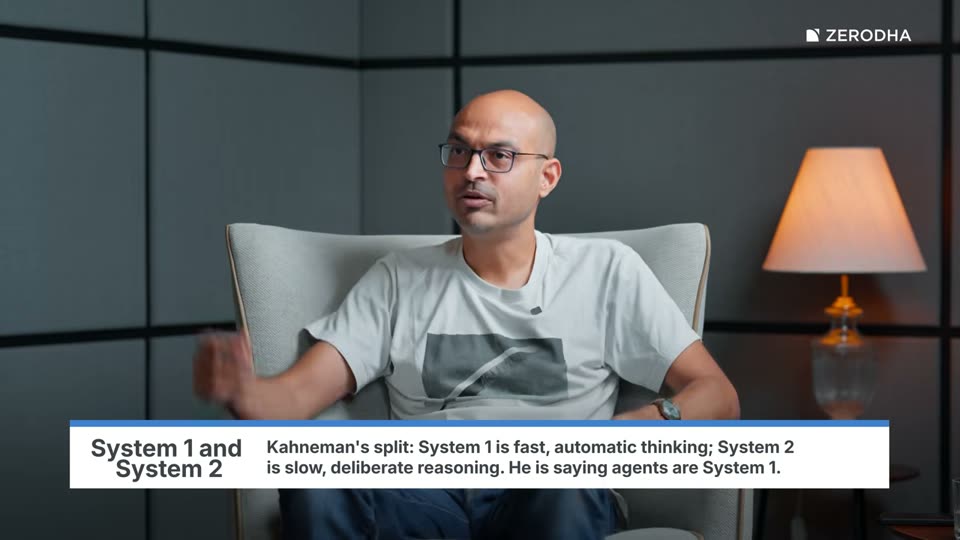
Once you accept that, a few uncomfortable things follow. The agent is only as good as you are. And the biases it amplifies aren’t the ones you already know about. They’re the ones you can’t see, because it’s trying to please you. He calls that an infohazard, and he was serious about it.
The other consequence is practical. If you make hundreds of small decisions a day with an agent, some will slip past you, and tomorrow’s work gets built on top of them. His estimate is that today you can keep building a system with an agent for about two weeks before it starts to rot at the architecture level. I don’t know if two weeks is the right number. The shape matches what I’ve seen, though. The first few days feel like magic, and the trouble shows up later, in places that are hard to trace back.
Why he calls Realfast a manpower company
This was the part that I found interesting. If almost everything changes every three months, he says, you shouldn’t plan around what will change. You should look for what won’t, which he calls an invariant. The one he trusts most is that a human has to stay in the loop, holding the few architectural pillars the agent keeps drifting away from.
So he has built Realfast around people and is open about what that costs him with investors.
“Building a manpower company is the kiss of death in the venture funded ecosystem … But it turns out that the only Lindy thing over here is people.”
He also changed how he thinks about pivots. Realfast spent its first two years building to a fixed thesis. Then, around Opus 4.5 in late 2025, the team started re-checking the thesis every time the models took a jump. Deals they’d been turning down as off-thesis became the business, and they went to seven-figure revenue within two months. His essay shown in the episode puts it at $100K in 2025 and more than $3M by July 2026.
The middle is gone
The idea in the episode I’d most like people in Indian tech to hear is the one about the middle band. A lot of the industry runs on an unspoken deal: for this work, average talent and average results are fine. That’s roughly the $20-30-an-hour developer India exports in huge volume.
Sidu’s claim is that agents didn’t make that band slightly better or slightly worse. They removed it. Hand a good-enough person an agent and they’re suddenly making three weeks’ worth of decisions in a day. Decision fatigue sets in, they stop checking, and slop gets in.
“Either they’re producing slop or they’re producing bangers.”
He doesn’t blame anyone for this. Aiming for good enough was the sensible strategy for a country that can’t produce a million IIT graduates a year. It has just stopped working. He calls this the foothills of the singularity, where perfectly sensible choices are suddenly invalidated.
I’m not sure he’s right that there’s no middle at all. I’d want to see it measured before I believed it fully. But I haven’t seen anyone produce consistently okay work with an agent either, and that’s the question he asked the hosts.
A few smaller stuff I found interesting and worth sharing
- Enterprises are stuck after a 1% rollout because, outside support and sales, nobody in B2B owns a metric, so nobody can show the CFO what changed.
- Speeding up one workstation on an assembly line often slows the whole line down. He used Toyota to argue that “productivity” is the wrong thing to measure.
- An AI course isn’t a scam, it’s just obsolete. Ask the AI to teach you.
- He only takes projects with a clear deadline and a clear line to revenue, and he won’t build a leave-policy chatbot for anyone.
- India shouldn’t try to copy the US or China. It should try to be a clear number three, and that means properly funding companies like Sarvam.
The explainer
I wrote the whole conversation out step by step, in the order Sidu builds the argument. It has his own words, links to the exact timestamp for each quote, all 28 on-screen definition cards, and five hand-drawn diagrams.
Open the step-by-step explainer →
Opens in a new tab. Every timestamp links back to the video.
If you have the time, watch the full episode. My notes leave out a lot of the asides, and some of the best lines are in them.
The quotes come from YouTube’s auto-captions. I fixed obvious caption errors and otherwise left the spoken wording alone.